
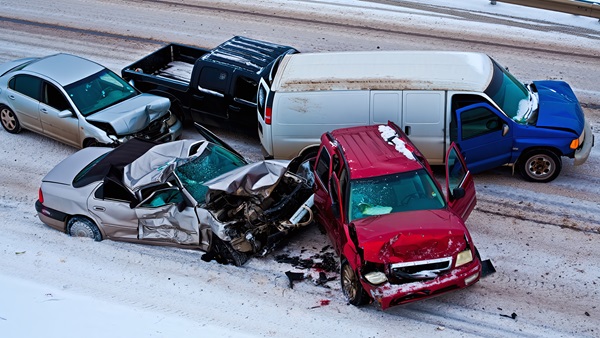
Imagine you’re stopped in your lane on a busy highway or in rush‑hour traffic. Then, suddenly, the car ahead of you jerks or stops. You tap your brakes, but the driver behind you doesn’t have the same luxury of space. The next thing you know, it’s not just one car hitting another, it’s a whole line of bumpers playing dominoes.
In a chain‑reaction car accident, the first driver’s mistake can ripple through several vehicles. But the question that really matters afterward is simple: who’s at fault? Figuring that out isn’t just about who hit whom first. It’s about timing, distance, behavior, and the rules of the road.
Who typically starts the chain reaction crash?
In most cases, the driver who triggers the first collision carries the bulk of the blame. That’s usually the person who rear‑ends the car in front, slams on the brakes for no reason, or swerves into traffic and knocks the first car off‑balance.
That initial impact is often the legal “spark” that sets off the rest of the collisions. Insurance companies and investigators tend to treat that driver as the primary at‑fault party, even if the domino effect pulls in three or four cars behind. The idea is that if that first impact had never happened, the rest of the pile‑up likely wouldn’t have, either.
When can other drivers in the line also be at fault?
Just because someone isn’t the first to hit another car doesn’t mean they’re off the hook. Fault can spread down the line when later drivers are also doing something risky. For example, a driver who’s tailgating in heavy traffic might technically not “start” the crash.
However, their failure to maintain a following distance means they can’t stop in time when the car ahead suddenly slows. A driver who’s speeding, distracted, or using cruise control in bumper‑to‑bumper traffic can also contribute to the chain by giving themselves less time and space to react.
What evidence proves fault in chain reaction crashes?
Figuring out fault in a chain‑reaction crash is a lot like putting together a high‑speed puzzle. Different pieces of physical and video evidence help show what really happened, second by second.
- Vehicle damage patterns: Front‑end and rear‑end damage show which cars hit others and which were struck from behind.
- Skid marks and tire tracks: Marks on the pavement reveal who was braking, who was still moving, and how quickly drivers reacted before impact.
- Roadway debris: The positions of glass, plastic, and metal on the roadway help map the sequence and direction of vehicles at the moment of impact.
- Video evidence: Dash‑cam and traffic‑camera footage can be synced to walk through the crash moment-by-moment.
- Accident reconstruction: Using speed, distance, and timing, experts determine who had a realistic chance to stop safely and who didn’t.
When can road conditions or vehicles also share blame?
Sometimes the story isn’t just about drivers. Bad weather, icy roads, poor visibility, or sudden flooding can make it hard for any driver to stop in time, even if they’re paying attention. Mechanical problems such as brake failure, tire blowouts, or burned‑out brake lights can also play a role. If a vehicle defect or shoddy maintenance can be proven, part of the fault (and the cost) might shift to the manufacturer or the shop that worked on the car.
In rare cases, poor road design or maintenance, such as confusing lane merges or missing guardrails, can bring government entities into the picture. This doesn’t mean drivers are off the hook. However, it does mean fault can be distributed more broadly than just among the people behind the wheel.
How does the state’s fault law shape the outcome?
Colorado uses a modified comparative negligence system, which means fault is divided among everyone involved in the crash, and that division directly affects what each person can recover. If you’re found 50% or more at fault, you generally can’t recover compensation from the other driver. However, if your share of fault is below 50%, you can still seek damages, reduced by your percentage of responsibility.
Your recovery is then adjusted to match your share of fault. For example, if one driver is found 30% at fault, another 50%, and a third 20%, the driver who is 30% at fault would see their compensation reduced by 30%, while the driver who is 50% or more at fault may be barred from recovering from others.
In multi‑vehicle pile‑ups, insurance companies often try to shift as much blame as possible onto drivers in the “middle” or “back” of the chain to protect the front, primary at‑fault driver, which makes solid evidence and a precise, second‑by‑second timeline especially critical in Colorado cases.
What should you do if you’re caught in a multi‑vehicle pile‑up?
If you’re ever in a chain‑reaction crash, here’s what you should do:
- Move your vehicle off the road if it’s safe to do so, turn on your hazard lights, and call 911.
- Ask for a police report that includes all vehicles and witnesses.
- Take photos and videos of the scene, showing vehicle positions, damage, and weather or road conditions.
- Get contact information from every driver, passenger, and nearby witness.
- Keep all your medical records and receipts if you’re injured, and don’t rush to accept a settlement that only covers the first car’s damage.
- Treat the crash as a serious, multi‑party incident, especially on busy highways or during rush hour, where the ripple effect can be much bigger than it first appears.
In the heat of a chain‑reaction crash, it’s tempting to apologize or say something like “I guess I was too close.” That can come back to haunt you later. Insurance companies can twist those words into an admission of fault, even if the full picture is much more complicated. Also, avoid signing any releases or accepting quick settlement offers right after the crash. Evidence might still be fresh, but the true picture of fault isn’t fully clear. Never provide a recorded statement to insurance companies without a lawyer present.
Why can getting a lawyer early make a difference?
Chain‑reaction crashes often involve several insurance companies, each focused on protecting its own driver. Having a Colorado Springs car accident lawyer who understands how investigators reconstruct multi‑vehicle crashes can help balance the playing field. That’s where The Longo Firm, LLC comes in.
We can secure and preserve evidence, challenge unfair fault assignments, and investigate whether road conditions or vehicle defects played a role. Plus, it costs you nothing upfront to work with us. We offer free consultations and work on a contingency fee basis. That means we only get paid if we win your case. To find out how we can help you, contact us online or call to book a free consultation.
“Stephen Longo was a very hands-on lawyer with my car accident. I was hit by a truck that pulled out and hit the side of my car. Stephen helped to make sure I received all the care needed to get help from the accident. He also helped me to receive a settlement to take care of the bills for the accident. A very dependable lawyer who was always in contact with me. I highly recommend him. Thank you, Stephen!” – James, ⭐⭐⭐⭐⭐