
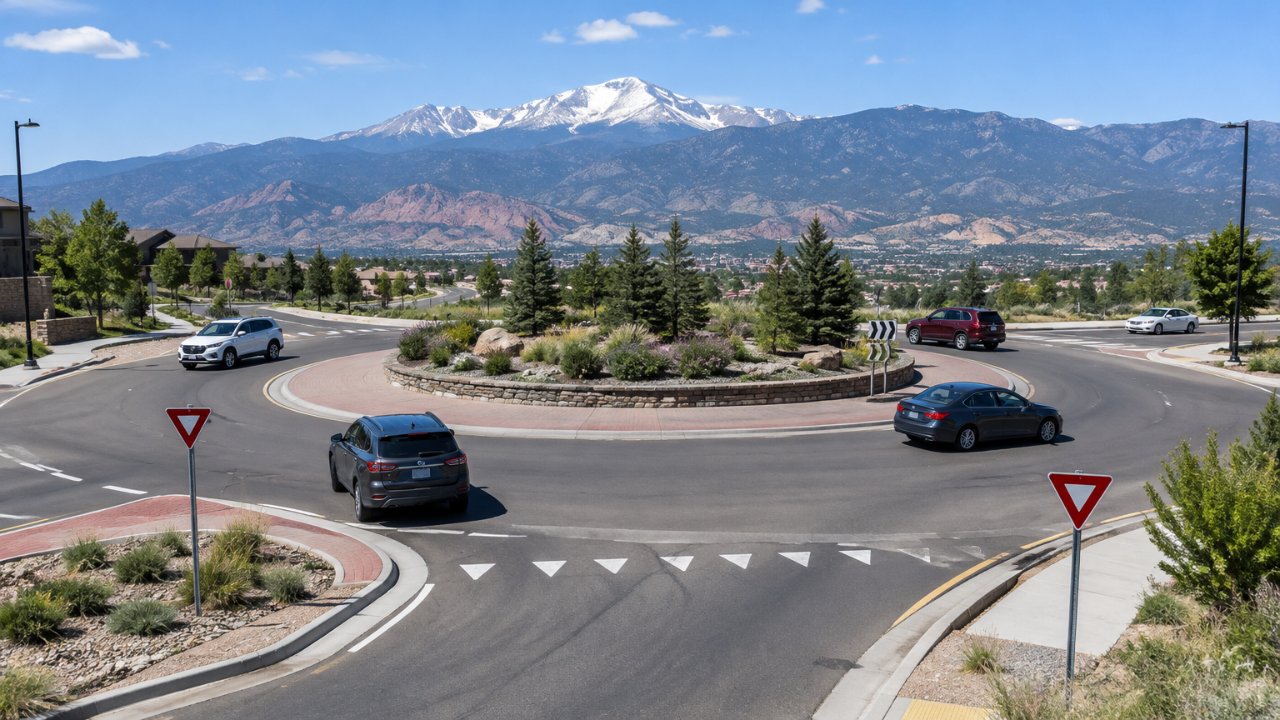
New Roundabouts at Peterson Road Mean New Rules for Drivers, and Mistakes Can Lead to Serious Crashes
Roundabout right of way is about to matter more for Colorado Springs drivers. Crews are building two roundabouts where US 24 meets Peterson Road, near Peterson Space Force Base’s north gate, according to KRDO. One will sit on each side of the highway overpass, replacing an interchange first built in the early 1960s.
The work has already changed how drivers move through the area. Lanes have shifted and traffic patterns have changed. Many drivers who’ve used the old interchange for years will have to learn new habits. Roundabouts are designed to make intersections safer, but only when everyone follows the same rules.
When someone doesn’t, the crash that follows often turns into an argument over who should have yielded. Settling that argument starts with what the rules required and who broke them, which is where a Colorado Springs car accident lawyer like Stephen Longo comes in. The answer matters, since fault decides who pays for the injuries.
|
Roundabout Rules at a Glance
|
What’s Changing at Peterson Road and US 24
The $15 million project will put a roundabout on each side of the US 24 overpass at Peterson Road. KRDO reported that the project reached about its halfway point on Oct. 21, 2026. That day, crews moved one lane of traffic in each direction onto newly paved lanes on the east side of Peterson Road. That let paving start on the other side.
The interchange handles a heavy mix of traffic. Drivers head in and out of Peterson Space Force Base and travel along Space Village Avenue. Others are getting on and off the highway. The project also includes improvements for pedestrians, who will need to cross near the new roundabouts. Officials expect the work to wrap up by mid-2027.
Until then, drivers face shifting lanes, temporary signs, and changing traffic patterns. Construction zones create their own risks. Drivers who expect the road to look the way it did last week are especially vulnerable. Those risks don’t end when the roundabouts open, since many drivers will still be learning how to use them.
How Right of Way Works in a Roundabout
The most important roundabout rule is simple. Drivers entering the circle must yield to traffic already in it. The Colorado Department of Transportation’s (CDOT) roundabout design guide describes traffic moving counterclockwise around a central island. Entering vehicles yield to circulating traffic.
That means a driver at the entry should slow down, look left, and wait for a safe gap. Yield signs at each entry reinforce the rule. Drivers must also yield to pedestrians and cyclists in the crosswalks before entering and again when exiting.
Once inside, drivers should keep moving to their exit rather than stopping in the circle. Stopping unexpectedly can cause the driver behind to rear-end the car. A driver who enters without yielding and hits a circulating car usually carries most or all of the blame.
Two-Lane Roundabouts and Choosing the Right Lane
Larger roundabouts often have two lanes, which adds another layer of rules. Many crashes in these roundabouts happen when drivers pick the wrong lane or change lanes inside the circle.
- Choose Your Lane Before Entering – Signs and pavement arrows show which lane to use for each exit.
- Use the Right Lane for Right Turns – The right lane usually handles right turns and sometimes straight-through traffic.
- Use the Left Lane for Left Turns – The left lane usually handles left turns, U-turns, and sometimes straight-through traffic.
- Don’t Change Lanes Inside the Circle – Switching lanes mid-roundabout is a common cause of sideswipe crashes.
- Give Large Trucks Room – Big trucks may need both lanes and the raised center apron to get through.
- Signal Before Exiting – A right turn signal tells other drivers where you’re headed.
One common two-lane crash happens when an inside-lane driver exits across a driver in the outside lane. Lane markings and signs often decide who was in the wrong. Photos of those markings taken right after a crash can make a big difference in proving fault.
Common Causes of Roundabout Crashes
Roundabouts reduce many of the worst types of crashes, like high-speed T-bone collisions. They don’t eliminate crashes, though. Most roundabout crashes happen when a driver fails to yield at the entry. That driver pulls into the path of a car already circulating.
Other drivers enter too fast, misjudge the curve, or get distracted while trying to read the signs. Some change lanes inside the circle or cut across another vehicle to reach an exit. During construction, temporary lanes and changing signs can add to the confusion.
These crashes often cause side-impact and sideswipe injuries, including neck and back injuries, concussions, and broken bones. Pedestrians and cyclists near a roundabout are especially vulnerable. Drivers often watch only for cars coming from the left.
Who’s Usually at Fault in Common Roundabout Crashes
Roundabout crashes tend to fall into a few familiar patterns. Here’s how fault usually breaks down and what evidence helps prove it.
| Crash Type | Who Usually Should Have Yielded | Evidence That Helps |
|---|---|---|
| Entering Driver Hits a Circulating Car | The entering driver | Damage location, witness statements, dashcam video |
| Sideswipe Inside the Circle | The driver who changed lanes | Lane markings, vehicle positions, video |
| Inside-Lane Driver Exits Across Outside Lane | Usually the driver who cut across | Lane-use signs, pavement arrows, photos |
| Rear-End Crash at the Entry | Usually the following driver | Following distance, speed, witness accounts |
| Pedestrian Hit in a Crosswalk | The driver | Crosswalk markings, video, witness statements |
These patterns are starting points, not final answers. Speed, signals, and the layout of a specific roundabout can change the analysis. Learning how fault is determined after a Colorado car accident can help injured drivers understand what to expect.
How Colorado’s Comparative Fault Rule Affects a Roundabout Claim
Colorado follows a modified comparative fault rule. An injured driver can recover compensation if he or she is less at fault than the other driver. Any award is reduced by the injured driver’s share of the blame. A driver found 20 percent at fault, for example, recovers 80 percent of the total.
The cutoff matters. A driver found 50 percent or more at fault recovers nothing under Colorado law. In a roundabout crash, both drivers may claim the other should have yielded. A few percentage points can decide whether an injured driver receives anything at all.
Insurance companies know this. They often argue that both drivers were confused. They may also claim the injured driver entered too fast or picked the wrong lane. Clear evidence about who had the right of way can push back on those claims. Our firm moves quickly to lock down that evidence before it disappears.
When Construction Zones Play a Role
Some roundabout crashes involve more than two drivers’ mistakes. During construction, confusing signs, poorly marked lane shifts, or missing warnings can contribute to a crash. Contractors responsible for traffic control may share the blame when their setup falls short.
Claims involving a government agency follow special rules. The Colorado Governmental Immunity Act generally requires written notice within 182 days of discovering the injury. That deadline is far shorter than the time allowed for most car accident claims.
These cases take quick action and careful review. Photos of the work zone, signs, and lane markings taken right after a crash can be critical. Whether a contractor or government agency also belongs in the claim is worth answering early, since claims against public agencies come with their own notice deadlines.
Evidence That Shows Who Should Have Yielded
The proof of who had the right of way can disappear within days, especially in a work zone where lanes and signs keep changing. These records often decide how fault is divided after a roundabout crash.
- Medical Records – Neck injuries and concussions don’t always show symptoms right away, and prompt treatment records tie the injuries to the crash.
- Police Report – The report records the scene, the drivers involved, and what witnesses told officers at the time.
- Scene Photos – Pictures of yield signs, lane markings, pavement arrows, and final vehicle positions show how the crash unfolded.
- Dashcam and Traffic Video – Footage can show exactly who entered the roundabout and when, before memories start to differ.
- Witness Accounts – Other drivers and pedestrians can confirm who had the right of way and who cut across a lane.
Colorado generally allows three years to file a lawsuit after a motor vehicle crash, but evidence fades much faster than that. The other driver’s insurance company may also call early asking for a recorded statement, and anything said can be used to shift blame. Sending all contact to a lawyer protects the claim and the proof that shows what really happened.
When You Call Longo, You Get Longo
At The Longo Firm, LLC, Colorado Springs personal injury lawyer Stephen Longo handles every case personally. There are no case managers and no getting passed around. Stephen gives every client his cell number and stays involved from the first call to the final resolution.
Stephen is a member of the Multi-Million Dollar Advocates Forum. His case results include a $1.8 million recovery in a car accident case. They also include $375,000 for a crash on a residential street. He prepares every case as if it’s going to court, and insurance companies know it.
Hurt in a roundabout crash in Colorado Springs? Leave the fight to Longo and get honest answers about your case.
“Stephen was amazing. His determination and perseverance in getting us what we deserved was outstanding!” — Frederick B., ⭐⭐⭐⭐⭐